
This Way, Cycling Hours in the Cellar Don't Hurt Anymore
By Emil Bischofberger
Suddenly there is a pinch in the knee or back on the exercise bike. A bike fitter can help recreational athletes. We tested three in the Zurich area.
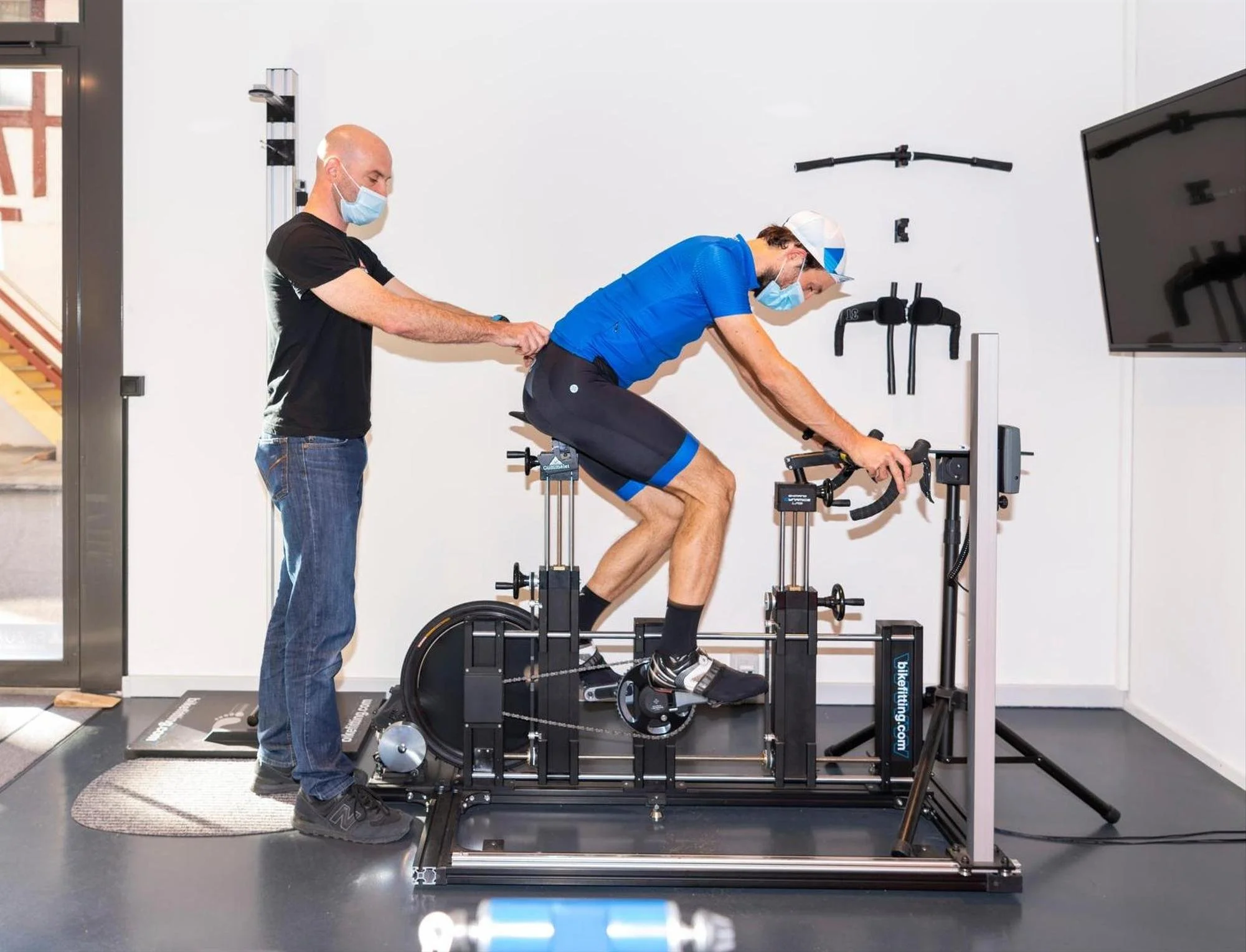
Man and machine: The technology of the tting simulator is only benecial if the tter (in the picture: Marco Suozzi) knows how to use it.
Photo: Urs Jaudas
A racing bike is actually not a science: the saddle is pushed up so far that the leg is almost stretched at the lowest point on the pedal - done. The vast majority of cyclists proceed in this way when they adapt a new racing bike for themselves. You swing in the saddle, roll away and never look back.
A racing bike is actually not a science: the saddle is pushed up so far that the leg is almost stretched at the lowest point on the pedal - done. The vast majority of cyclists proceed in this way when they adapt a new racing bike for themselves. You swing in the saddle, roll away and never look back.
Unless something starts to hurt after a few kilometers. Maybe in the back. Maybe in the knee. Maybe in the seating area. The problem can overtake beginners as well as seasoned gummers.
In winter, these problems occur more frequently when the racing bike is installed on the training roller in the basement - because the athlete remains in the same posture all the time, unlike when riding outside. “I keep hearing the statement: 'I've tried racing bikes. But everything always hurt me. That's why I stopped doing it again ›», says Marco Suozzi from the Gümmelei bike shop in Wallisellen. "It doesn't have to be: there is the right position for every person."
The bike industry has recognized bike fitting as a line of business. In the Zurich area there are offers of just under 200 to 600 francs.
With a bike fitting, the ideal sitting position is determined. On the one hand, it is considered a solution for complaints of all kinds. On the other hand, it is a possible adjustment screw when it comes to optimizing your own performance on the bike.
The bicycle industry has recognized the branch of business, which is also shown by the impressive number of bike fitters in the Zurich area. There are more than a dozen offers from just under 200 to 600 francs. There are big bike brands behind many bike fitting systems. At the same time, the industry is confusing: there is no generally recognized training. Which means that the quality and type of fitting depends very much on the experience and style of the fitter.
Gümmelei: Entry into the world of bike fitting
Suozzi is one of the cheapest providers. For just under an hour and a half of fitting, he charges 187.50 francs. «I haven't had 20 years of experience yet. That's why I consider it a fair amount, ”he says. Suozzi opened the Gümmelei 14 months ago, from the beginning bike fitting was one of his mainstays, so now 180 fittings have come together - in addition to the ones he had previously performed with friends. The seating position of the customer's bike is measured with a laser and copied onto the simulator. From there, Suozzi makes adjustments, starting with the pedals, then the saddle and finally the handlebars.
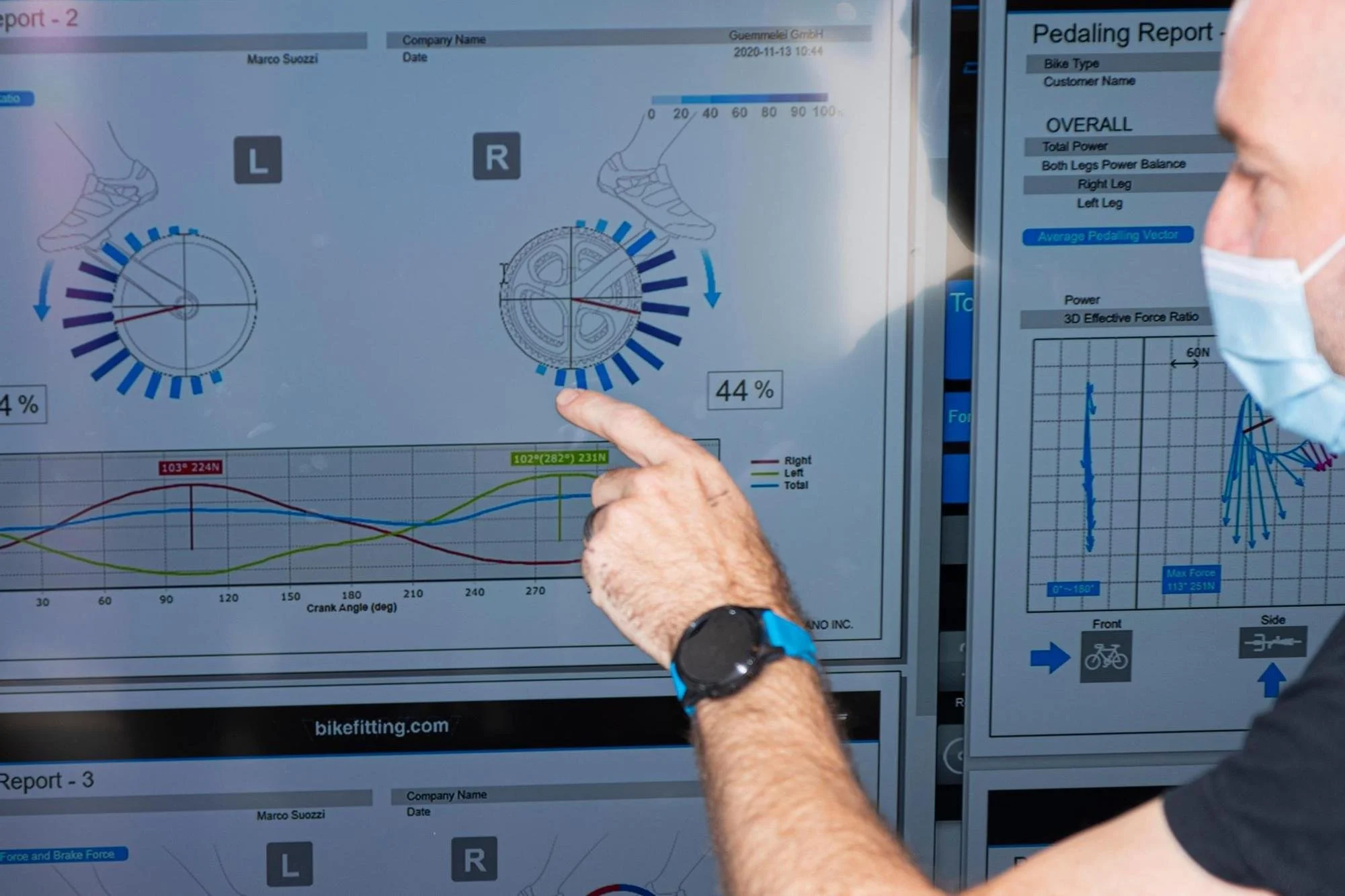
Lots of data: Gümmelei's bike tting simulator also shows how efcient the pedal movement is.
Photo: Urs Jaudas
With our tester, the changes are minimal. Suozzi suggests raising the saddle 5 millimeters and lowering the handlebars 1 centimeter. At the same time, Suozzi says: “Less than 20 percent of all cyclists sit well on their bikes. Only: if you are not in pain and are not a competitive athlete, you don't have to change anything. " The exciting thing about Suozzi's system is that it also measures how efficient a position is. It is a good introduction to the world of bike fitting.
Tempo sport: more cycling lesson than fitting
In Horgen, René Kuster from Tempo-Sport has a completely different philosophy: he relies solely on his eyes for bike fitting (CHF 360 / approx. 1 hour). Kuster has been fitting for over ten years and relies on "over 40 years of cycling experience". As a result, he could roughly imagine how to drive more economically. He installs the customer's bike on a training roller in the middle of the shop, which is surrounded by mirrors. “I'll explain to you how cycling works, what economical power transmission is,” says Kuster. With this fitting there is hardly any tinkering with the seating position - unless Kuster finds glaring mistakes in the adjustment of the bike. No, it focuses on the cyclist's pedal movement.
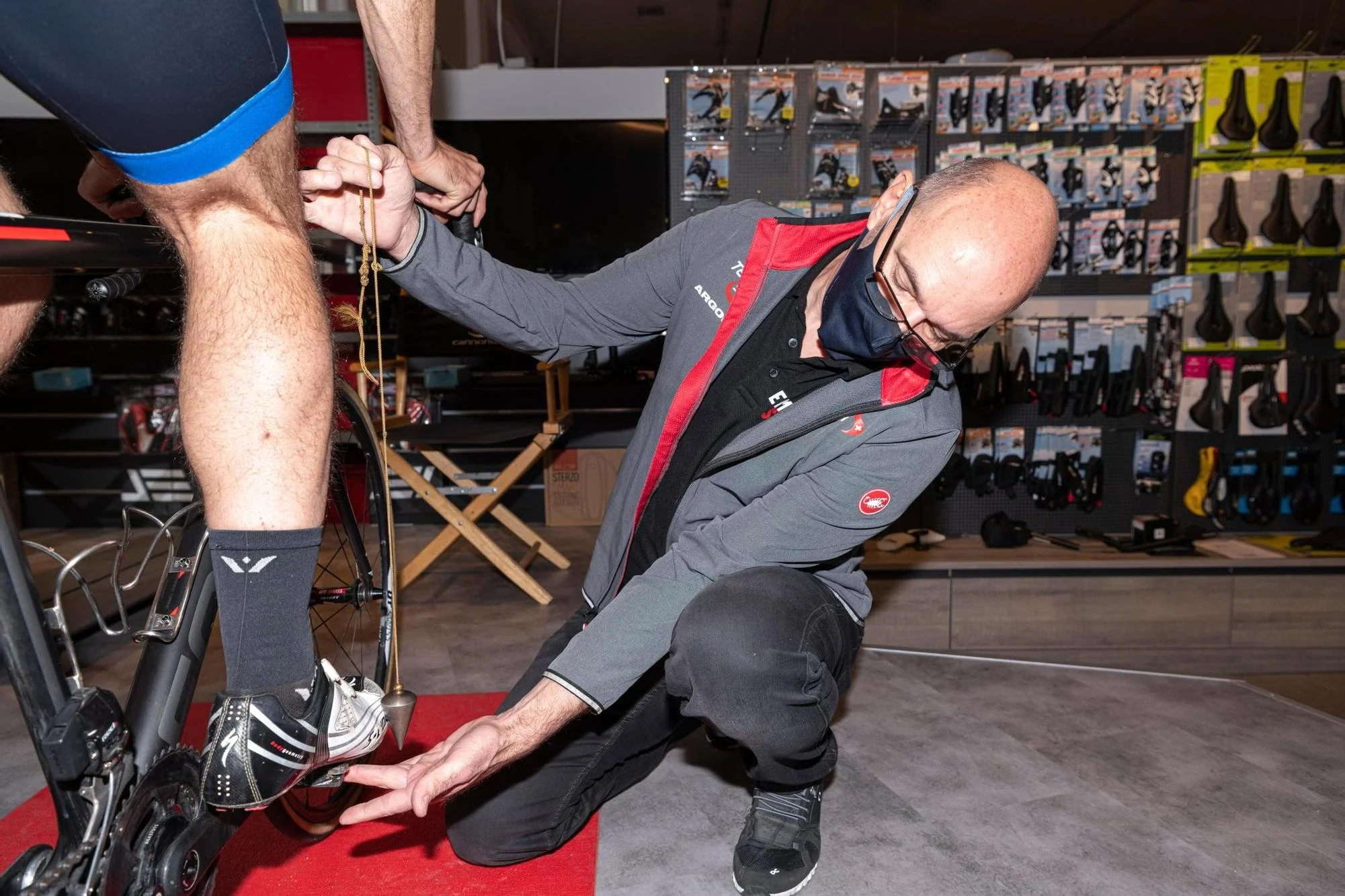
Every tter has his own approach: René Kuster from Tempo-Sport checks the pedal position with a plumb line.
Photo: Urs Jaudas
To some extent, Kuster is the antithesis of the typical bike fitting, at the end of which the customer receives an evaluation with all the dimensions of his bike and many other key figures. “That's okay for someone who knows how to cycle and wants to get the last 10 percent out. But he gets the first 90 percent here from me, ”says Kuster. The lesson is worthwhile: the beginner then has an inkling that cycling requires significantly more technique than just alternately pedaling. And the advanced student realizes that despite his experience, he still has a lot to learn. Two findings from many: The much-invoked round step does not exist. And for people with a fixed training role in the basement, it is worth installing a mirror next to it: the learning effect,
Cycle Store: New insights for the experienced racing cyclist
The Cycle Store Zurich on Werdmühleplatz offers one of the most progressive bike fittings (CHF 380/2 hours). Its simulator is called Guru. The guru is much more the operator of the system, Chloe Murdock. The American has been working in the Cycle Store since this summer and is likely to be the most experienced bike fitter in the Zurich area. The trained physiotherapist has already performed 2500 fittings in her career.
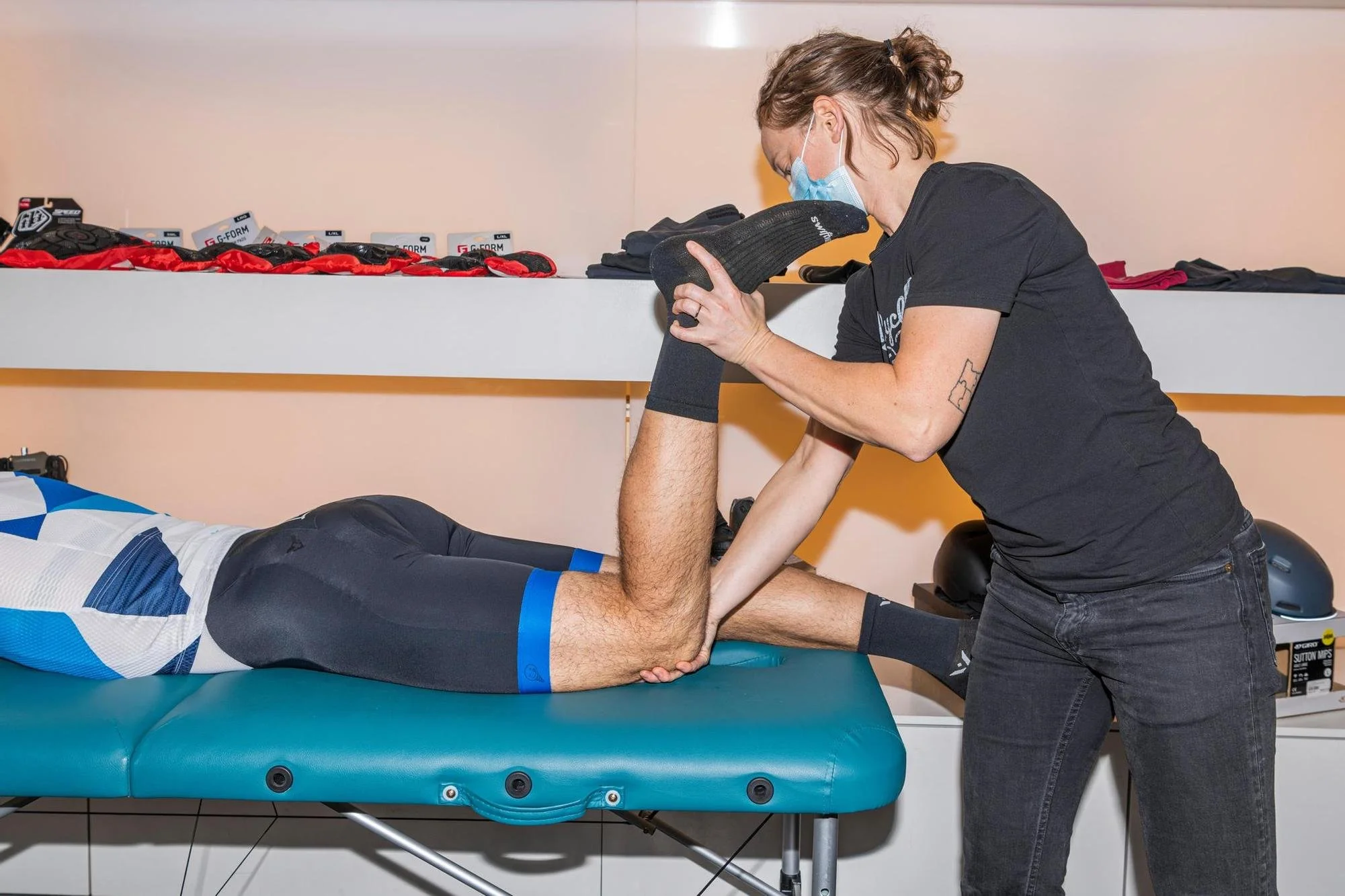
Comprehensive clarication: The trained physiotherapist Chloe Murdock from the Cycle Store Zurich checks the mobility of the cyclist.
Photo: Urs Jaudas
Of the three fitters, Murdock goes into the greatest detail. It first tests the athlete's body for mobility and possible imbalances. Then change the position of the plates on the bike shoes minimally - and with great effect. They are not interested in the customer's previous seating position: they should find a new one from scratch on the Guru Simulator. This works because with the Guru system the sitting position can be changed while the customer is pedaling. This has to give the fitter permanent feedback as to whether his position feels better or not. This is exciting for a rider who knows what racing cycling feels like and can therefore feel subtle changes in position. For a beginner, on the other hand, we would advise a more conventional fitting.
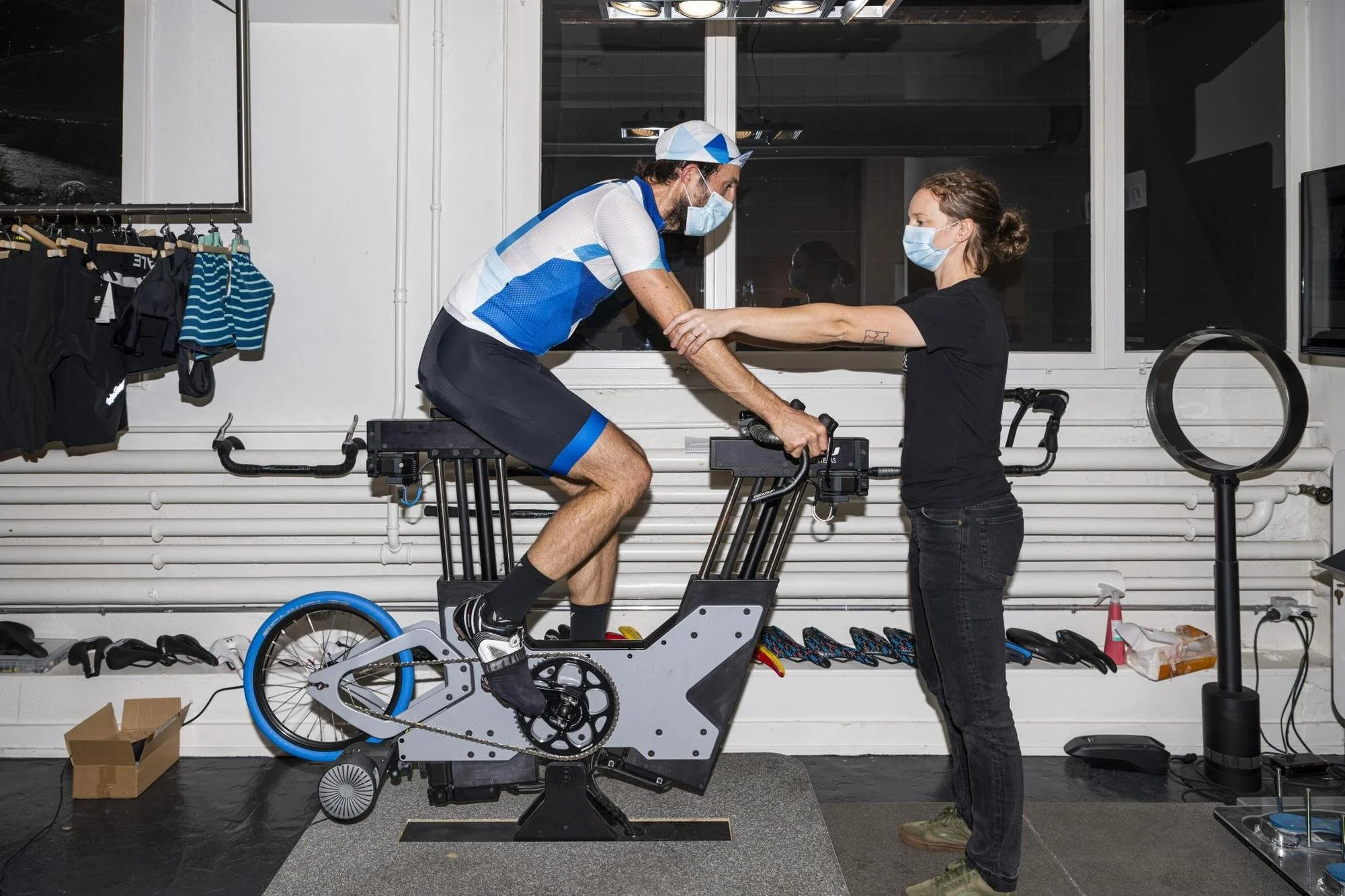
Physiotherapist Chloe Murdock adjusts the sitting position while the driver pedals and gives constant feedback.
Photo: Urs Jaudas
The guru session ends with the most obvious change in seating position: the saddle and handlebars move three centimeters together, the latter also moving 1 cm down. But even this measure alone will not remove all problems by magic, but the tester will have to sweat even without a bike: Murdock sends a list of torso exercises the day after the fitting.